STEAM Education
Eight STEAM Skills Kids Actually Build When They Fly a Drone
February 18, 2026 7 min readBy Courtney Owens
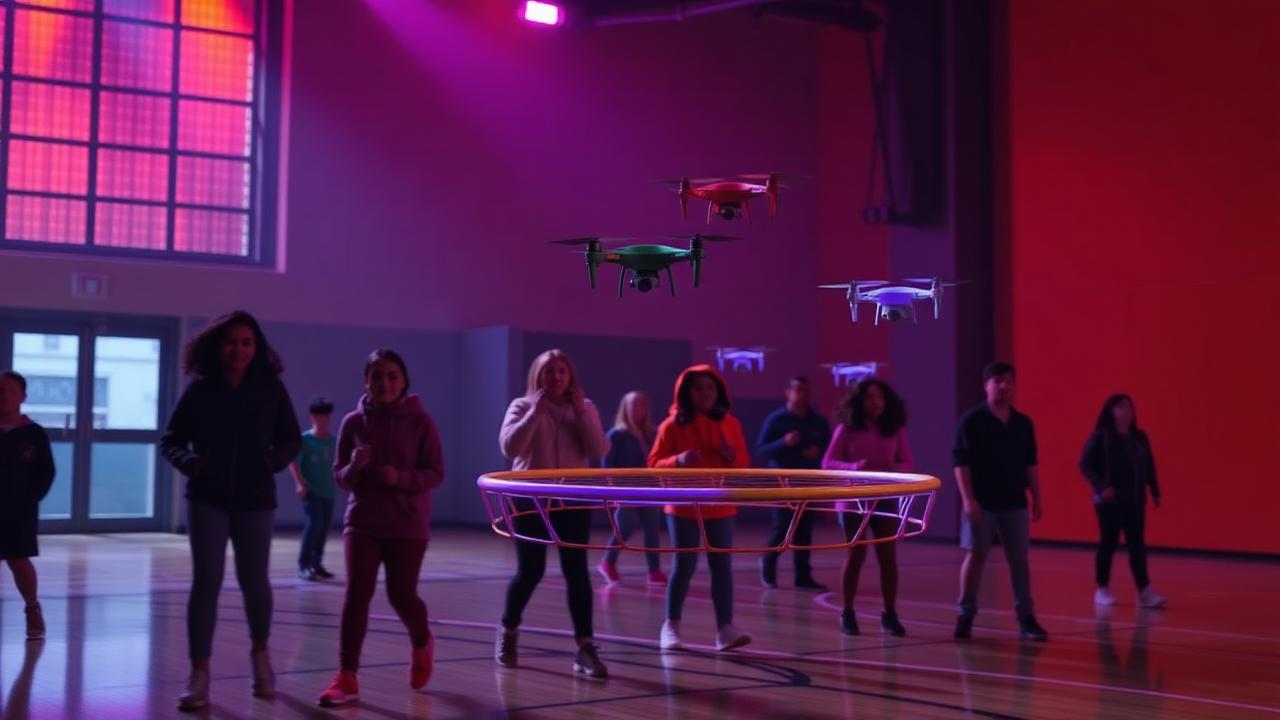
From the doorway, a drone club looks like recess with better equipment. Kids are laughing, aircraft are buzzing, someone is chasing a runaway quadcopter across a gym floor. It is fair for a parent to wonder where the learning is. The answer is that drone flight compresses an unusual number of academic and professional competencies into a single activity, and most of them are invisible unless you know what to look for.
1. Spatial reasoning and orientation
The hardest part of learning to fly is not the throttle. It is the moment the drone turns around and faces the pilot, and every control input reverses. Pushing right now moves the aircraft left from the pilot's point of view. Students have to hold two reference frames in their head at once and translate between them in real time.
This is the same cognitive skill that underpins geometry, engineering drawing, surgery, and reading a map. It is trainable, it is strongly correlated with success in technical fields, and it is rarely taught directly in school. Drone flight trains it for an hour straight without a worksheet in sight.
2. Physics you can feel
Drones make abstract forces tangible. Students discover inertia when a drone keeps drifting after they release the stick. They discover ground effect when the aircraft becomes squirrelly close to the floor. They discover that battery voltage sag reduces available thrust near the end of a flight. Nobody has to define momentum; they have already fought it.
3. Systems thinking
A drone is a system of subsystems: power, propulsion, flight controller, radio link, sensors, and airframe. When something misbehaves, students learn to isolate which subsystem is responsible rather than declaring the whole thing broken. Diagnosing that a drone drifts because a propeller is chipped, not because the controller is faulty, is authentic engineering practice.
4. Risk assessment
Before every flight our students run a checklist and answer three questions: what could go wrong, who could it affect, and what will I do if it does. That habit is the core of professional aviation and it is transferable to driving, chemistry labs, construction sites, and every job that involves consequence.
5. Iterative problem solving
Nobody flies a clean figure eight on the first attempt. Students fail, adjust one variable, and try again. The tight feedback loop — attempt, observe, adjust — is the scientific method compressed into thirty-second cycles, repeated dozens of times per session. Students who normally shut down after one failure stay engaged because the next attempt is always ten seconds away.
6. Precision and fine motor control
Holding a stable hover at eye level requires continuous micro-corrections on two thumbsticks. Students learn that smaller inputs produce better results, which is a genuinely counterintuitive lesson for young people whose instinct is to push harder when something is not working. The skill transfers to any tool that rewards restraint over force.
7. Communication under pressure
We fly in crews. One student pilots, one acts as visual observer calling out hazards, one manages the checklist and timer. Roles rotate. The observer has to give clear, concise, actionable information while the pilot's hands are busy. Vague warnings do not work; clear ones do. Students learn the difference in a single session.
- Callouts must be specific: not 'watch out' but 'wall on your left, three feet.'
- The pilot acknowledges every callout out loud so the crew knows it was heard.
- Anyone on the crew can call an abort, and nobody is allowed to argue with an abort call.
8. Creative framing and visual storytelling
This is the A in STEAM, and it is the part that hooks students who do not consider themselves technical. Once a student can control the aircraft, they start composing shots. Where should the camera be? What does a slow reveal feel like compared to a fast push in? Suddenly a kid who came for gadgets is learning framing, pacing, and editing, and they are doing it because they want their footage to look good.
What this adds up to
None of these skills are drone-specific. Spatial reasoning, systems thinking, risk assessment, iteration, precision, crew communication, and visual composition are the raw materials of engineering, medicine, logistics, film, and the trades. The drone is a delivery mechanism for a curriculum that students opt into voluntarily.
That voluntary part matters enormously in the communities we serve. Attendance is the prerequisite for every other outcome, and students show up for drones. Once they are in the room, the rest of the learning follows.
If you want to see it in person, our youth drone sessions in Portsmouth begin with an intro class and continue with ongoing flight training. Come stand at the edge of the flight box and watch what a crew of twelve-year-olds sounds like when they are running a disciplined mission. It does not sound like recess.
Stay in the loop
Get the next guide before the next flight day.
Courtney Owens
Education Director, The Okii Dream Initiative
Part of the team running drone flight, aviation technology, and STEAM programs across Hampton Roads, Virginia.